Showing posts with label Zombie Renaissance. Show all posts

Monday, December 8, 2014

People Killing People: 28 Days Later and the New Zombie

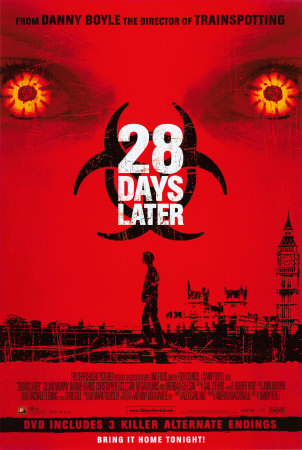
The first "modern" (post-2000) zombie film that we covered in class this year was Danny Boyle's 28 Days Later. For this film, I wanted the class to investigate how these zombies differ from the ones we saw in Night of the Living Dead and Dawn of the Dead, and explore what those differences might have to say about our culture. Here is the assignment (my model blog entry follows right after):

This week we will be watching Danny Boyle's 2002 film, 28 Days Later (NOT the sequel, 28 Weeks Later). One of the more interesting things about this movie is the way that it dramatically reimagines the zombie figure. It challenges, in some very overt ways (and some more subtle ones) the rules and conventions that we have become accustomed to in zombie fictions. For this blog, I want you to identify a few of the ways that these "zombies" differ from the ones we've seen in Romero's films. I would rather you pick the one or two differences that most interest you and focus on them, as opposed to attempting to catalog every way that these zombies are different and new. Once you have explored these differences, I want you to make an argument about what this shift in the presentation of the zombie indicates about our culture. Why did the zombie have to change to fit our current sensibilities? What does this new zombie say about us?

In 1968, George Romero presented us with a new vision of horror: the zombie. For almost 35 years, his presentation of the zombie was the standard, some slight deviations aside (“Braaaains!”). The 2002 release of 28 Days Later changed all of that. Indeed, in many ways, Danny Boyle’s new iteration of the zombie acts as an update of sorts, a reimagining of the creature to suit the shifting sensibilities of modern audiences.

At its core, the Romero zombie is a slow-moving, mindless, reanimated corpse that craves human flesh and multiplies by killing its victims, and can only be stopped by a direct attack on its brain. There are a few other traits from Romero’s films that have fallen away in other representations – rudimentary tool use, a fear of fire, eating crickets, etc. – but the traditions that have loosely been followed for over three decades are based on those characteristics explicitly outlined by the “experts” on the news in Night and Dawn.
The “zombies” we encounter in 28 Days Later are decidedly different. Perhaps unsurprisingly, they are never identified as “zombies” in the film. These creatures, though in many important ways zombie-like, are never identified as such by the characters in the film. Instead, they are referred to as “the infected.” Unlike in Apocalypse Z, however, where this term is also used (perhaps a little more euphemistically) to describe the monsters that have caused the fall of civilization, here the term is used literally. Whether it is the doctor at the beginning of the film explaining what has been done to the chimps, or Selena giving Jim the worst while-you-were-sleeping talk ever, when viewers are told that what caused this outbreak “was a virus, an infection,” it is meant quite literally (19:44). These “zombies” are not reanimated corpses, they are infected humans. Which is to say, they aren’t dead, they just live differently. Very differently. But they’re still just… people. In 28 Days Later, Danny Boyle confronts his viewers with monsters, infected and not, that are stunning in their very humanity. Although the infected are quite different from those not afflicted by the virus - they cannot communicate, they are basically mindless, are wildly contagious, and multiply at an alarming rate – they might be most frightening in their awful similarities.


In another interesting departure from the conventions established by Romero, the “zombies” of 28 Days Later aren’t much more difficult to kill than an uninfected person. I mean, the infected the zombie figure clearly doesn’t react to pain the same way that people do; even engulfed in flames, they will continue their single minded pursuit of human destruction. They aren’t indestructible, though, and trauma to the brain is hardly the only way to dispatch them. Being riddled with bullets (1:04:19) or hacked up with a machete (28:17) is no less fatal to an infected person than it would be to anyone else. They can be burned, starved, or blown apart by claymores. Their tolerance for pain is higher, sure, even much higher, but there is nothing at all supernatural about these beings. Nothing more than sick, deranged people, these “zombies” are alive like us and die like we die.


Shifting the zombie figure from the nearly invulnerable risen-dead to simply "the infected," living people who have contracted an aggressively contagious virus, reflects what I believe is a growing skepticism of the supernatural at the time. Following the real life horror of 9-11, the world had less and less patience for paranormal ghouls and goblins. An audience that watched thousands of people die in a terrorist attack broadcast live on national TV didn’t need their dead to walk; their living were plenty frightening as is. In 1968, Romero frightened us not by making zombies believable, but by depicting realistic reactions to inconceivable, indeed impossible, events. The interpersonal conflict and the societal collapse of Night of the Living Dead could not but resonate at a time of so much social unrest and upheaval. Boyle is doing something else entirely. While Boyle’s film certainly speaks to a similarly pervasive cultural anxiety and uncertainty, his zombie is perhaps most horrifying because it obeys the laws of the universe as we know them. Doctors do experiment by creating new viruses and diseases. Viruses do mutate, often at an alarming rate. Our world is a very frightening and violent place. When Major West tells his assembled dinner party that what he’s seen in the four weeks since infection is simply “people killing people,” much like they always have, and asserts that this “puts us in a state of normality, right now,” he isn’t just talking about the world within the film; he’s pointing an accusatory finger at our reality as well (1:13:36). This, or something like it, could actually happen. It is this horrible, horrible plausibility that has allowed the zombie to re-take its place as our worst nightmare and preeminent monster.

Tuesday, October 21, 2014

Canon Update (10/21/14)

Lit:

    Novels-
World War Z, by Max Brooks

Although there are several films featuring zombies that I think have or will become considered part of the overall Western Canon – Night of the Living Dead and Dawn of the Dead are already part of the National Film Registry, while 28 Days Later and probably even Shaun of the Dead likely to end up on the list eventually (at some point I should probably seriously consider the fact that the two most well-regarded films of the Zombie Renaissance are both British films) – there are far fewer written zombie texts whose places are so secure. If I could only pick one zombie book or story to nominate for the Canon at large, it would be Max Brook’s World War Z. Though I’m hesitant to call it a novel (which I admit is probably splitting hairs), Brook’s mock-ethnography draws on the work of Studs Terkel to provide readers with a “look back” at the origins of a zombie outbreak in a time and reality not too distant from the ones they know. That’s actually selling Brooks short; his book reads horribly horribly true. Which is a bit surprising given its highly satirical approach (though it could be convincingly argued that the book is parody, allegory, pastiche, or even all of the above, as well). However you choose to categorize World War Z one thing is clear: the book is Max Brooks’s scathing critique of the world as he knows it. And it turns out, he knows it pretty well.
Traditionally, zombie narratives to be relatively local affairs. What would a zombie outbreak look like here, where “here” indicates some specific place and time (a rural farmhouse in the 1960s, millennial London, etc.)? While most of these texts at least imply that their particular iteration of the outbreak spans the globe (or will soon if it doesn’t already), World War Z is the first text that explicitly engages with the global nature of the pandemic. This serves two purposes. First, it allows Brooks to criticize everybody. Brooks is certainly extremely critical of late capitalism and the Western military-industrial complex, but these are hardly the only institutions to draw his withering gaze. Using a surprising breadth of knowledge regarding geo-politics and world culture, Brooks takes shots at, well, the whole world for what he regards as a universal inability to prevent or manage a cataclysm on this scale. Second, but along the same vein, situating his particular version of the zombie apocalypse as a global event allows Brooks to destabilize all of the imagined communities to which we so fervently cling. Zombies don’t respect borders, or faith, or class, or race, or politics, or gender, or sexual orientation, or any of the other ways we choose to group ourselves off from one another. By positing zombies as an Other for all of humanity, Brooks erases some of the lines between us, leaving a single, human Self. Of course, whether what’s left is worth saving is another question entirely.
Also, someone please make this into a series. Without meaning in any way to disparage or denigrate the wildly uninteresting, dumbed-down, and sterilized action blockbuster that shares its name, World War Z is simply not a story that is very well suited for film (even if the studio heads hadn’t decided to dip a good idea in glitter and deep fry it). However, a World War Z TV series, or even mini-series, told in flashbacks by an enthnographer and his or her interviewees (a similar structure has worked well in The Wonder Years and, more recently, How I Met Your Mother), would be pretty effing amazing. And I’m going to keep harping on it every chance I get until someone does the right thing and makes it happen.

    Other-
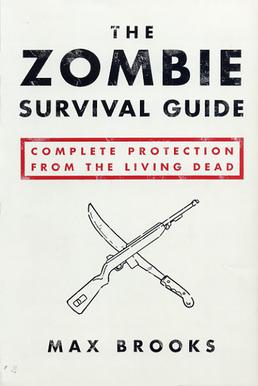
The Zombie Survival Guide: Complete Protection from the Living Dead, by Max Brooks

            I really don’t know what the hell to call The Zombie Survival Guide, as far as literature goes. I mean, it’s very clearly a parody, and a high level one at that, but how do you categorize a fictional field manual? Well, whatever you call it, it’s great, and its impact on 21st century zombie lit. is undeniable. Continuing the trend that began with the Resident Evil series, and spread to film with Resident Evil and 28 Days Later, The Zombie Survival Guide showed that zombie books could be both interesting and financially successful (working its way onto The New York Times Best Seller’s list). It also helped pull zombies out of what had become a fairly goofy horror/gore niche. Although it deals, often quite explicitly, with horrific material and even some gore, The Zombie Survival Guide is not a horror book. Rather, it uses horror as a tool (along with parody) to poke fun at how wildly unprepared our pampered society is for any high level disaster. We don’t even have basic preparedness, let alone “protection from the living dead.” But Max Brooks is really bright and rarely operates on only one register. So, while he is clearly parodying survival manual with pitch-perfect tone and satirizing Western privilege, he also uses his “Recorded Attacks” vignettes (gestured to throughout the book, and then expanded upon in an appendix at the end) to raise some really clever epistemological concerns over the certainty we tend to ascribe to history and how readily we believe the things we are told by the people we hold as experts. By mixing completely fictionalized accounts of history with other legitimate but inexplicable historical events (the chronicles of Hanno the Navigator or the disappearance of Roanoke Colony, for example), Brooks forces his readers – well, the ones who are paying attention – to question not only what they “know” but how they know it. 

Thursday, October 2, 2014

Canon Update (10/2/14)

Lit:

    Short Fiction-
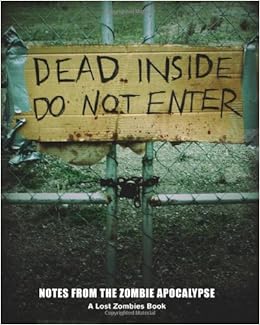
Dead Inside Do Not Enter: Notes From the Zombie Apocalypse, by Lost Zombies

            Realistically, this could have just as easily gone under an “Other” heading as “Short Fiction.” It certainly isn’t a short story in the way we typically think of them. In fact, it’s barely a story at all. Unless you count all of the blanks that you are asked to fill in on your own. What it is, however, is amazing. And unsettling. And heart-breaking. And terrifying.

I was tempted to label this book an epistolary novella, but I felt like that would really have been stretching each term towards its breaking point. It’s probably more like a scrapbook than anything. When the world is ending, what type of messages would we send? What would our last words look like as our culture failed? Instead of letters, the book is made up of a series of notes, written on all manner of scraps and fragments – notebook paper, birthday cards, lotto tickets, matchbooks, torn cardboard, whatever – that were ostensibly “discovered in a backpack […] in Northern California” following a zombie outbreak (Editor’s Notes). This collection of found correspondence is so pitch-perfect authentic in its depiction of the pettiness, humor, ignorance, and panic that would define our final moments that it hurts. The notes don't seem to be linked or arranged in any discernible way, and there is no real indication that the writers of any of them ever knew or met one another. However, what it lacks in narrative structure, Dead Inside more than makes up for in gut-punch effectiveness. Some of the letters are just close-the-book-and-sit-there-until-you-get-over-it awful. And almost never in a gruesome or gory way. This is horror at its most cerebral, because it makes you do most of the work. You have to buy this book (paperback, there are apparently formatting issues with the Kindle version).


Film:
Dead 28 Days Later, written by Alex Garland, directed by Danny Boyle

            Holy shit I love this movie. As important as the Resident Evil franchise was in re-introducing zombies to the popular consciousness, 28 Days Later stands alone as patient zero of the zombie renaissance. After a decade of Scream and I Know What You Did Last Summer movies, Boyle reminded us that horror could be smart. And following years of camp and exploitation - think Dead Alive and The Dead Next Door - he sure as shit showed us that zombies movies could still be scary again. 

Of course, Boyle certainly played with the form a bit to do so. For one thing, the film gives us our first look at fast zombies. I can almost hear the purists cringing, so let's get that out of the way. There is no shortage of people that don't consider 28 Days Later a zombie film - these "zombies" aren't dead or even undead (un-dead undead?), they don't seem to eat flesh, head-shots are not required to kill them, and they run for F's sake. All of that is perfectly true. And though I might find arguments against the zombie-ness of "the infected" compelling, this is without question a zombie movie. All of the hallmarks are there: contagion, ever increasing hordes of lethal beings, societal collapse, a band of survivors, even a weirdly well-lit shopping spree. Although the tweaks pull these creatures a little bit away from traditional zombie lore, these differences are instrumental in resituating the zombie as horrific to our current sensibilities. In the age of 24 hour news coverage and high-speed (hyper speed?) digital communication, slow, shambling zombies are a tougher sell as a terrifying force of (un)nature (one of the most impressive things about The Walking Dead is that it manages to convincingly present the slow-moving "walkers" as truly horrific). The now and right now generations need their zombies to move. 

Similarly, shifting the monster from risen dead to "the infected" reflects what I believe is a growing skepticism of the supernatural. Following the real life horrors of 9-11, the world had less and less patience for ghouls and goblins. We wanted our monsters to be real. Where Romero scared us with the zombie not by making us believe it, but by depicting realistic reactions to inconceivable, indeed impossible, events, the Boyle zombie horrifies us because it obeys the laws of the universe as we know them. This, or something like it, could actually happen. There is a horrible horrible plausibility here that has allowed the zombie to re-take its place as our worst nightmare and preeminent monster.

Saturday, September 20, 2014

Canon Update 9/19/14

Whenever I make additions to the zombie canon (hopefully once a week), I will post them directly on the canon page itself. However, I will also highlight the additions by giving them their own post as well.

TV:
The Walking Dead, developed by Frank Darabont, based on the work of Robert Kirkman

I really wish this wasn't so easily and obviously the only real entry under TV. Oh, I'm sure there are probably episodes from The Twilight Zone, Tales from the Dark Side, and Tales from the Crypt, but there is clearly nothing even close to The Walking Dead when it comes to its contribution to the zombie zeitgeist (which sucks; Zombieland was conceived for TV and would have been awesome, with the zombie kill of the week intended to be a weekly gag; and World War Z would have been infinitely more compelling had it been stretched into a TV series instead of smushed into a movie - it could've been our M.A.S.H.). 

If only based on its staggering popularity, the AMC ratings monster would demand a spot on this list. But it's actually really, really good. And bright in a way that I'm not sure even most of its most ardent fans give it credit for. The questions it asks of our society as we know it, and the remnants of it that would carry on, are disturbing to say the least. Plus, [semi-spoiler alert] the twist when the barn is opened in season 2, is one of the single most affecting moments in the nearly 50 year history of flesh-eating-swarm zombie fiction. Typing about it gives me goosebumps. 


Video Games:
Resident Evil (the series), created by Shinjin Makami


Resident Evil doesn’t get the credit it deserves. That’s unfortunate. Although the video games from the series, as well as the films, have all been commercially successful, they aren’t typically regarded with the same type of critical affection as their more literate zombie kin, 28 Days Later, Shaun of the Dead, or even Fido. However, there is almost no chance that the zombie renaissance as we know it (there’s nothing else to call it), to say nothing of the survival horror video game genre, would have occurred if millions of us hadn’t taken that first unpleasant trip to Raccoon City. Resident Evil did a lot more than prove that video games could be scary, though; it also helped reshape the way that we conceive of narrative. By offering players multiple endings based on choices they made while playing, Resident Evil helped usher in the age of video games that operated more as non-linear, interactive fictions than simple stories that players followed from start to finish. And they did it while making zombies scary (and cool) again.

My memories of playing Resident Evil in 1996 aren’t as clear as I’d like them to be, but I distinctly recall Resident Evil 2 scaring the shit out of me, even as a “macho” high school football player. These games, with their dicey controls and sometimes hilariously cheesy dialogue, were frightening in a way that zombie narratives hadn’t been in a very long time. Zombies had been fun in the 80s, and kitschy cult cool, but they probably hadn’t been really terrifying since Dawn of the Dead. As part of this project, I’m going to revisit these games, to try to pinpoint what made them such the perfect vehicle to remind us how awful the walking dead can truly be.