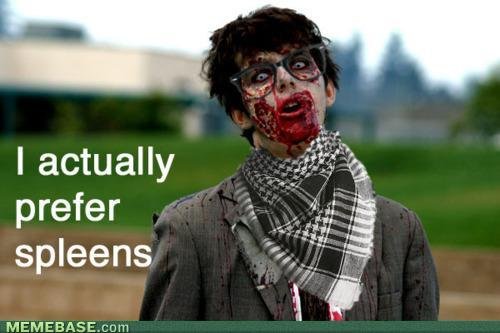
Showing posts with label Media Literacy. Show all posts

Wednesday, November 12, 2014

Just Ad Zombies... (conclusion)

To clarify, although I was very critical of the zombie ads that I’ve discussed here and here, for the most part I actually enjoy the commercials that I’ve derided so far. The ads are fun, but I don’t think they show any real understanding of how zombies function or use them in a way that is consistent with the very loose constraints of the “genre” (stretching that word a bit, but you know what I mean).
Zombies: You're doing it wrong
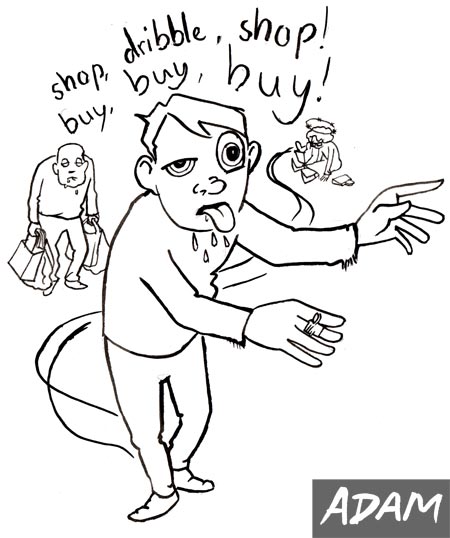
I try very hard not to be a zombie snob, and I’m far from a purist – I am pro fast-zombie, for the record, and I absolutely love Scott Kenemore’s Zombie, Ohio, which centers around a zombie that thinks and talks – but the ads that I’ve already gone over were very clear examples of bad zombies. However, their failures as zombies underlie an interesting point: the zombie figure is so fluid that its relative success or failure isn’t predicated on what the zombie itself does or does not do – whether it talks or moans, walks or runs, eats human flesh or any flesh – but rather on the effect it has on its audience. Zombies, whether they are horrific or comedic, traditional or modern, operate by playing on specific concerns and anxieties that permeate our culture. Mortality, contagion, ineffective government, over-reliance on technology, to name just a few. The safe, sanitized, and stupid zombies (even the ones that seem to have high IQs) from these commercials don’t do any of that. As such, they are entirely superfluous and unnecessary. Interestingly enough, though, these ineffectual zombie presentations actually operate on a certain figurative zombism in their target demographics. What type of person buys cars, or even candy, because of a clever commercial? Deep critical thinkers? Discerning shoppers? Or mindless consumers impelled only by desire?
Here's a hint: 
via AdamWilson.info

But enough complaining. My endless bellyaching notwithstanding, there are some really good zombie commercials out there that not only stay true to the conventions that have come to define the zombie over the last 45 years and reflect the cultural uncertainties that have shaped them, but also effectively market the “products” they are trying to sell. I had to throw scare quotes there because the first commercial I’m going to talk about is apparently selling CPR. As in cardiopulmonary resuscitation. Which isn't really a product. Or for sale. Anyway, check out this great spot from the Heart and Stroke Foundation of Canada.

posted by Heartandstrokefdn on Youtube

Okay, first things first: it’s kind of cheesy. Not full on cheese, mind you, but not exactly Frank Darabont either. The makeup is actually pretty good and the ad is well-edited, but the music and fog are a bit over the top and, more importantly, it doesn't push the zombie figure much past cliche. Beyond that though, the primary slogan, "CPR makes you undead," while clever, might also be confusing (2:36). Because, um, being undead is... ungood (doublplusungood, even). Once you look past the obvious flaws, however, this commercial does a lot right. Though cliched, the zombies are friggin' zombies. They're bloody, they swarm, they eat warm flesh, and they are most certainly contagious. What's more, they are clearly set apart as something the viewer does not want to be or become. Zombie = bad. Simple. The protagonist, for her part, is readily relatable; i.e. she provides a clear Self for viewers to align with. She does what we would like to think that we would do. When she recognizes danger, she runs from it. When she falls (it's not her fault she's a white lady in a horror clip), she capably defends herself, even beheading a zombie. Her desire to stay alive is a counterpoint to the zombies desire to end it, both of which reinforce the idea that "being alive is a good thing." Which is a big part of the message that the commercial is trying to get across. 


Being alive is good and CPR keeps you alive. That message becomes a little muddled after the zombies resuscitate the woman only to devour her - So it keeps you alive long enough to die a more horrible death? Sweeeet! - but overall I think it accomplishes its two goals rather well. The first, as I've said, is to spread the message that CPR saves lives (if only temporarily). However, it also wants to briefly instruct viewers how to react when someone suffers cardiac arrest. By providing 3 simple, easy to remember instructions, "1. Call 9-1-1. 2. Push hard and fast about twice every second. 3. Don't hesitate, you can't do harm," the clip situates CPR as something that anyone can do (1:43). Not only do you not need more training than a commercial provides, you don't even need a functioning brain. Whether or not that message is actually true or not is irrelevant. What matters, rather, is that that is the message (more or less) that they want to convey, and they do. Don't hesitate, i.e. don't worry, don't even think.
Your reaction to cardiac arrest should be a mindless response, an instinct so profound not even death via a zombie plague  would erase it from your memory: CPR, now. There are certainly problematic readings that could be made about a commercial that only appears interested in keeping us alive long enough to be consumed and to become consumers, but for right now I'm more interested in how well it achieves its goal of increased CPR awareness. 

I'd like to close with my favorite zombie commercial. It's not the funniest, and it might not be the most memorable. It certainly isn't selling anything as worthwhile as CPR. But it gets zombies in a way most of the others just don't seem to, and that sets it apart. I don't have a problem with funny, snarky, or happy zombies (Snow White and the Seven Commercial Zombies?), but fear sells and zombies can be very scary, so why not use them that way? Diehard, a brand whose name just seems to beg for them to use zombies in their marketing, does. 

To begin with, this commercial isn't being cute. It starts out in full out life or death flight from a pursuing horde of ravenous zombies. Who, by the way, are serious business zombies. They're fast, they're scary, and, though the commercial has quick cuts that never really focus on them for too long, they definitely look the part. Make no mistake, broad daylight or not, this is a horror commercial and that makes a huge difference. Because it lets the zombies do what zombies do - they aren't here to talk shit on the bus or pick you up at a bar, and they definitely aren't here to save your life. These zombies want to eat your face. ASAP. And they should. 

BECAUSE THEY'RE ZOMBIES!

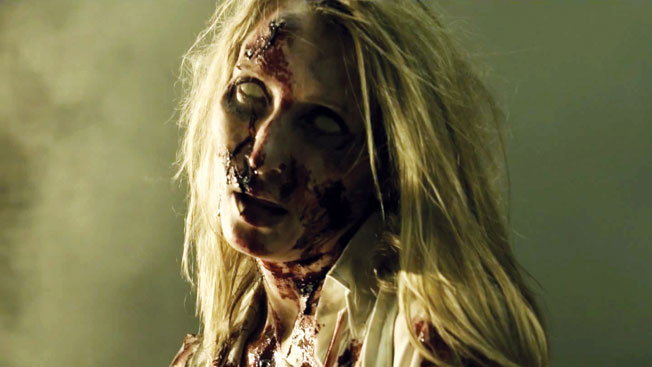
Zombies can do a lot of other things, but the thing they should want to do more than any other is make you look like this


Of course, it's not just the zombies that have our friend here looking like she wants to cry because of how real shit just got: she is also horrified by the behavior of her fellow survivor, who couldn't spare even a second of effort to try to help her escape the zombies' grasping hands. This is a dynamic, while extremely familiar to even the most casual zombie fan, that none of the other commercials have ever approached. Diehard clearly sets the humans as Self that the audience sides with out of a shared desire not to get eaten, and the zombies as the awful Other that we don't want to become or be near, but they don't hide from the fact that sometimes, especially during the zombie apocalypse, the Self kinda sucks. A lot of the tension in zombie narratives is actually provided by the troubling, dangerous, or selfish actions of other humans. This ad does a great job of setting the humans (unnecessarily) at odds with one another in their attempts to survive. So Mr. Think-for-himself-er runs off and abandons the pretty, seemingly helpless woman and 30 seconds in we still have no idea what they hell is going to happen or, more important given the context, what the hell we're supposed to buy. Suspense is a valuable tool for a commercial. It keeps you from changing the channel (why aren't there more horror ads?). Anyway, what we learn by the end of the clip is that during a zombie outbreak your chances of survival are only as good as the choices you make.
This begins with a decision to forsake a friend in need (a decision that gets reciprocated), but ultimately centers around a choice in car battery brands. Other brands don't last and will let you down when you need them. Other brands will get you killed. Seriously, selfish dude gets eaten. Diehard we see, however, is durable. Reliable. Safe. When the world goes to shit, when your government and police have failed you, when your friends let you down, Diehard will still be there to start your car. When the dead rise to eat your face "Life Demands Diehard."

It's an effective ad (like the CPR ad, it actually shows its product doing what it is supposed to do) and it employs zombies in a way that is consistent with the conventions that have made them so popular: a group of antagonistic survivors versus a horde of zombies - mindless, flesh-eating zombies. None of the other commercials come close to getting zombies this right (even the fairly well executed CPR spot). I don't know that that's going to make me more likely to buy a Diehard battery or not, but I appreciate the effort.

What'd I miss? What other zombie ad campaigns have you enjoyed? Or disliked? Let me know in the comment section below.

Friday, November 7, 2014

Just Ad Zombies... (cont'd)

Picking up where we left off, the Sprint Zombie isn't even the most egregious example of an advertisement  that chooses to associate its target audience with what is supposed  to be the zombie Other (as a brief aside, when I assign the human and the zombie the roles of Self and Other, respectively, it is an over-simplification of a binary relationship that is always inherently problematized. The human almost always pushes towards traits identified with the zombie Other, and the zombie's similarities to the human Self are just as frequently highlighted. What is [mostly] consistent, however, is that the audience is situated to associate with the human survivors). For that we'll turn to the New York Lottery. 

First, I want to give credit where credit is due: the zombies are very well done, particularly given the limitations of creating an ad suitable for network television. The commercial begins by making its way through a vacant and desolate city before focusing in on a diverse group of survivors (well at least it got that part right) attempting to make their stand at a woefully unfortified dry cleaner/laundromat. As the zombies finally inevitably force their way through the giant, not at all boarded up or obstructed window, the tv comes to life with a familiar refrain (at least if you've watched television in the state of New York in the last two decades or so): "The New York Mega-Millions Jackpot is Now..." And then a curious thing happens - well, curious to me at least; the zombies completely lose interest in human flesh and begin to shuffle off, suddenly surprisingly spry, in search of more desirable prey. Lotto tickets. Not to be outdone, the humans take off in hot pursuit: "Make way for the living!"


Okay, so on the surface, we have a few fairly obvious messages. First, the lotto is for everyone. Suit or flannel, hockey stick or broom, black or white, man or woman, human or zombie - EVERYONE wants in on that Mega-Millions Jackpot. Beyond that, though, having a ticket is apparently important. Life or death, undying desire type of important. For a commercial, these are exactly the messages you want to send. So far, so good, right? As long as you don't muddle anything up by actually thinking. 

Here are some other messages the commercial sends that don't require much in the way of minute analysis. For one thing, humans are dumb and wildly incompetent - if you "hide" from the zombie apocalypse in a plate glass storefront, with no bars and no boards over the door or window, and attempt to defend yourself with a broom, well, you're a moron and you deserve to get eaten. So we start off by asking us to align ourselves with idiots. Thanks for the vote of confidence, NY Lotto. Once we find out what product is being marketed, however, the mad dash for tickets asks us at least in part to "think" like a zombie. Which is to say, mindless consumers drop everything to buy lottery tickets, we should too. A message reinforced by the fact that the humans use their fortuitous reprieve not to seek real shelter or find actual weapons, but to run with the zombies to find a store that sells Mega-Millions tickets. A tacit admission that your product is aimed at customers who purchase without thinking seems like an odd approach. But, then again, what're the chances that their target demo picked up on the embedded implication? I don't mean to be too hard on the dedicated lotto players out there - I've played before. A dollar and a dream, right?

I worry that I'm being a bit of a spoilsport right now. These commercials are trying to be light and fun and I'm holding them to a standard that they never had any intention of meeting. I blame PBS. I've searched and searched and searched and I can't find it, but they used to have a show that had a panel of guests from different fields that would sit and dissect various popular commercials. I've been watching ads critically long before I had any idea that media literacy even existed (ugggh, I'm a media literacy hipster).
I laughed WAY too hard at this
by:Brootaldud @funnyjunk.com
I've always enjoyed reading between the lines when I watch commercials, good and bad, trying to locate various possible interpretations - whether intended or not - determine who the target demographic is, etc. In many ways, this type of rudimentary (at least early on) analysis laid the foundation for my eventual appreciation of literary criticism. Teasing out multiple meanings, pulling on all the loose threads - it's like a game. But a game that sometimes ruins the fun. 


I wanted to like the Happy Honda zombie. I really did. He just seems so... nice. I want to want what he has. Friends, fun, a catchy theme song, sweet  sweaters, and an urban titanium metallic Civic with voice-activated calling. Undeath doesn't look half bad. In fact, according to the commercial's title, It's Good to Be a Zombie. If what you want more than anything is utter conformity. 

Clearly, a large part of the horror of the zombie is that any sense of Self is subsumed into the horde. There is no individual will or agency. Just mindless conformity through boundless craving. Here, though, there's a bit of an inversion. Instead of humans losing their sense of Self by becoming one of  the multitudinous Other, we see a lone zombie attempting to lose his Self to become, or at least seem to become, more human. When I think about it too much, happy zombie makes me sad. Because he isn't being himself. There's no blood on his lips. No viscera staining his argyle. I guess you could argue that maybe the Happy zombie shouldn't be viewed as trying to fit in with the humans, but as not worrying about not fitting in with the zombie. While slightly more positive, this outlook remains troubling because it still situates individuality within a willingness and ability to fit in. And how do you show that you fit in? Well, you dress a certain way, of course. You listen to a certain type of music (One Week of Danger by The Virgins). And you buy the right shit. Drive a beat ass old Buick like the dude at the stop light and you'll have no friends, no music, no life. Buy a sweet Civic and you get to hit the driving range and then grab some beers with Gary. The world is your zombie oyster.

"To each their own." As long as their own is like everyone else...

Tomorrow, I'll finish up with zombie marketing by looking at  a couple commercials that actually use zombies in interesting and authentic ways (gasp!).

Wednesday, September 3, 2014

But I Don't Want to Be a Zombie!

Hey, let’s all pretend to be our own worst nightmare!

Ummm. No.

Can’t I just pretend I didn’t get eaten and die and come back, instead?

Perhaps one of the most persistently fascinating manifestations of the zombie’s overwhelming popularity and ascension to its undisputed position as the monster of the 21st century, people everywhere gleefully gather dressed and made-up as undead corpses. And I mean everywhere. 


There are zombie proms


Zombie baseball games


Zombie pub crawls


Indeed, nearly every major city in North America has a zombie walk of some kind and most have become annual events (really, it’s more of a global phenomenon: London, Paris, Moscow, Recife, and Santiago all stage their own annual events as well). While these events are often held to raise money for charity or to try for world records, or even just to boost ticket sales, the explanation for the number of people that show up to these events year after year to shamble and moan with each other is simple: people enjoy pretending to be zombies. The more interesting (and difficult) question, however, is “Why?” What is it about this particular monster, and this particular time, that has allowed the zombie to transcend Halloween and the isolated cult followings typically enjoyed by most horror figures to achieve such cultural ubiquity?

Hello, my name is Emmanuel Abreu, and I am a Master’s candidate in English at SUNY Buffalo State. This blog is the focus of an independent study that I am conducting as part of my degree program and is one component of a three part attempt to make sense of all this zombie madness (that’s right: Buff State lets you study zombies and still takes you seriously). Although the other two parts will not, for the most part, intersect with this blog, I would still like to mention them briefly.

My Master’s thesis, “‘They’re Us, That’s All’: Zombies and the Horror of Familiarity,” explores the role of horror and “monsters” in shaping any culture’s understanding of itself by looking specifically at the development of the zombie figure over the years before focusing on zombie literature and film from the first decade of the 21st century. Ultimately, my thesis argues that what is most frightening about the zombie is not how different it is from us, but how similar.

In addition to my thesis, I am also co-teaching a senior seminar course at Buff State with my thesis adviser, Dr. Lorna Perez, as part of a Master’s project. The subject? Zombie fictions (predictable?). The course is designed to investigate how zombie narratives function to reflect and respond to various societal concerns and cultural anxieties. Working from the cultural studies model, we will be reading various zombie “texts,” including novels, short stories, and films, and discussing what they have to say about the culture that created them. My output for the project, however, will be a conference paper that considers various approaches to integrating film and alternative media into a literature classroom: not just to supplement texts, but as texts themselves.

Which brings me back to this here zombie blog. This blog is dedicated to everything that my project and thesis do not address. Everything that falls through the cracks. Because that’s where the meat is! TV shows, graphic novels and comic books, mass zombie gatherings, and ad campaigns. I also want to pay particularly close attention to the pervasive presence of zombies on the internet. So much of our engagement with the zombie figure finds its outlet online - in blogs and social media, on message boards and other online communities, or with self-made Youtube movies  and crowd-sourced fiction like Dead Inside: Do Not Enter (a brilliant little epistolary “novel” created by Lost Zombies, a Bay area social network). By and large, though, these “texts” are ignored, both critically and in the classroom. This blog is my attempt to bridge that gap, to explore these works and interact with these communities where they reside. Sometimes serious. Sometimes silly. All zombies, all the time. Hopefully you enjoy the ride.