So, in my travels across the online zombieverse, I recently came across the pretty hilarious video below while browsing The Zed Word Zombie Blog and it reminded me of a question I've been worrying around for quite some time. But first, enjoy a Bad Lip Reading of AMC's The Walking Dead (from the folks over at BLR).
So much genius and hilarity and amazingness in such a short video. But I don’t really want to talk about the clip. We can get into what
makes zombies so open to parody and the weird dynamic between horror and comedy
when I talk about Evil Dead: The Musical tomorrow. What I’m more interested in
right now is the fact that this clip was first published a year and a half ago
(!). I thoroughly enjoy Bad Lip Reading, I clearly have a borderline unhealthy
fascination with zombies, and I’m a big fan of The Walking Dead, and yet, somehow,
this little clip of wonderful didn’t make it across my path until late last
night. Now, I can explain that away fairly easily by pointing out my almost
complete lack of a presence on social media (I miss out on some viral stuff)
and a general avoidance of Youtube as a recovering addict (one click leads to… all the clicks). That’s easy. What I find
less easy to account for, however, and thus more interesting to consider, is
the similar belatedness that seems to define literary studies. Even within a
cultural studies approach, in which the field of inquiry is opened to regard
nearly everything a culture produces as a readable, interpretable texts, there
seems to be an overall inability to engage the new.
But is it an inability or an unwillingness?
While there is no question that zombies are finally getting the critical attention they deserve, and I don’t think it can quite be said that the zombie wave has crested (it’s close, but not quite there yet), I can’t help but feel that academia might have shambled up to the farmhouse a little late on this. Not too late, by any means, but late enough to matter. This sweet new blog, for example. I’ve always been interested in the progression of academically sanctioned forms of
 |
| This is what the "academic establishment" looks like in my brain |
“literature,” and wanted to use this platform to explore that issue a bit. Take novels: initially, they were very much frowned upon by the academic establishment, deemed low entertainment for idle minds. Eventually, though, novels gained such widespread acceptance, even prominence, that they now dominate the (mostly theoretical) Western canon. There was a similar trajectory for film, though it has yet to quite attain the novel’s revered status, and television (the best of it) and comic books (call them graphic novels, if you want to; they’re comic books, and that’s okay) are not far behind. My assumption, is that video games too will one day make this leap. No matter how much they kick and scream about it, sooner or later, serious scholars will have to acknowledge that video games are an increasingly important aspect of how our culture tells itself stories. And then, sometime in the future, after video games start having
their choice-driven, non-linear, narrative structures analyzed and parsed in
college classrooms, maybe, blogs
might start being treated as though they have lasting cultural and artistic
merit. Of course, maybe I’m wrong and someone like Gregory Cowles is correct
when he says that even the best blogs are “too topical and too fleeting to count as literature.”
I mean, I'm not wrong. But maybe...
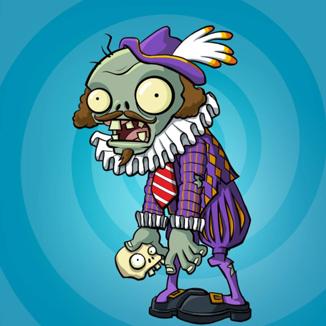
Nah, blogs will be literature one day. The same way the
Grasmere and Alfoxden Journals are considered literature now (they sound kind of
bloggish to me). Though, to be clear, I don’t mean to imply that all blogs have
artistic merit. Or all TV shows, comic books, films, or novels either, for that
matter. There’s quite a lot of rubbish out there. But that’s always been true.
We don’t read or teach every shitty sonnet that was written at the turn of the
17th century; we focus on Shakepeare and Spenser, because they wrote
the good ones.
I’m not so much worried about whether or not the academy
will start paying critical attention to blogs and video games. It’ll happen. It
has to. But to return to my original point (kinda), why do we, as a discipline,
have to wait? As I’ve been looking for interesting zombie blogs to explore
and/or analyze as part of my own project, I’ve noticed that many, though not
all, of the most intriguing zombie blogs are no longer being maintained. I can
still read their posts, of course, and provide commentary on them, but I’ve
missed the opportunity to observe them and interact with them while they were
active. Which is comforting in a way, because it's what I'm used to. But it's also a lot less fun, don't you think? Is there something about literary studies that makes it tend
more towards archaeology than anthropology? Why are we so much more interested
in poking the skeletal remains than the dynamic body? Thoughts?


